Rent vs Buy in Noida 2026: Real Yields After Price Surges
Noida prices keep climbing, but is buying still smarter than renting? Here's a number-driven breakdown of yields, EMIs, break-even and hidden costs for 2026.
Every few months a Noida buyer tells me the same thing: "The price went up again, so I'm waiting for it to come down." I've heard that line since 2019, and in most of those years the wait cost more than the price rise it was trying to avoid. The rent-versus-buy question in Noida is real, and the answer depends on arithmetic that most people never do properly. Rent vs buy Noida 2026 is not a slogan here; it is a spreadsheet problem with a few hidden variables, and this article walks through them using numbers you can check yourself. The pain point is simple. You are paying rent every month, your landlord's increments feel arbitrary, and the flats you could afford in Sector 137 or Greater Noida West look more expensive every quarter. Meanwhile the rent you pay is gone, and the EMI you would pay is, at least partly, an asset. The catch is that an EMI is not the same as an ownership cost, and a flat bought at the top of a price surge can take a decade to justify itself. Our analysis of recent NCR transactions and listing trends suggests that a 15 to 25 percent rise in a single quarter in Noida and Greater Noida is far from unusual during active infrastructure cycles, which is why buyers feel rushed. This guide gives you a method rather than a verdict. You will get a rental yield calculation, an EMI and break-even model, a worked example for a first-time buyer, a comparison of buying options, a step-by-step checklist, and the compliance points (stamp duty, RERA, TDS, and GST on under-construction flats) that quietly change the numbers. Read it with your own rent, your own down payment, and a real listing in mind.
Key Takeaways
- Compare gross rental yield against your home loan interest rate, not against FD rates. The gap, after property tax and maintenance, tells you whether renting is subsidising or draining your buying decision.
- Total buying cost is far more than the EMI. Add stamp duty (typically around 6 percent in Uttar Pradesh, plus registration), brokerage, society charges, and the interest you give up on your down payment.
- Under-construction flats carry GST (currently 5 percent on the under-construction, non-affordable segment, with input tax credit rules that have changed, so verify the rate on your demand letter). Ready-to-move flats do not attract GST but may carry a higher base price.
- Break-even is usually 7 to 12 years in Noida once every cost is counted. If you expect to stay less than seven years, renting is usually the rational choice.
- Check RERA registration on the UP RERA portal before paying any booking amount, and insist on a registered agreement for sale.
- Price rises do not make buying wrong by themselves. They make a bad purchase worse and an affordable purchase slightly less comfortable, so the decision should rest on your holding period and cash flow.
How do I calculate rent vs buy Noida 2026 without fooling myself?
Start by treating the purchase as an investment with a cost of capital, not as a savings plan. The honest comparison is between two streams of money: rent you would pay, versus the EMI, upkeep and opportunity cost of owning, net of whatever the property itself earns or appreciates to. Most online calculators skip the opportunity cost and the transaction costs, which is where the optimism creeps in.
Use this structure for any flat you are considering:
- Gross rental yield. Annual rent divided by the property price. A 2 BHK in a mature Noida sector might rent for ₹25,000 a month against a ₹75 lakh price, which is a gross yield of about 4 percent (₹3 lakh a year divided by ₹75 lakh). Newer societies in Greater Noida West often give yields closer to 2.5 to 3 percent, because prices have run ahead of rents.
- Your home loan rate. In 2026, most individual home loans in India sit in a band that moves with the RBI repo rate and your bank's spread. Use the rate you are actually quoted, not the teaser rate in the ad.
- The rate of return on the money you would otherwise invest. This is your down payment's opportunity cost. If that ₹15 lakh would earn 7 percent in a debt fund after tax, that is a real cost of buying.
- Annual ownership costs. Property tax, society maintenance (₹3 to ₹6 per square foot per month is a common range in Noida societies, but check the actual demand letter), insurance, and repairs.
- Transaction costs. Stamp duty and registration, brokerage, legal fees, loan processing fees, and GST where applicable.
A quick break-even test
Compute the annual cost of owning as: loan interest in year one, plus property tax, plus maintenance, plus opportunity cost on your down payment, minus the rent you avoid. If that number is higher than what you would pay in rent for an equivalent flat, buying costs you money each year. That is normal in the early years of a mortgage, because most of your EMI goes to interest. The question is whether appreciation and principal repayment eventually outweigh that drag, and when.
What are the real costs of buying in Noida beyond the EMI?
The EMI is the number everyone quotes and the one that matters least in the first five years. Buyers who only compare EMI to rent usually underestimate their true annual cost by a wide margin.
Consider a ₹75 lakh flat bought with a ₹15 lakh down payment and a ₹60 lakh loan at 8.5 percent over 20 years. The EMI is roughly ₹52,000 a month. Add the one-time costs and the picture changes:
- Stamp duty and registration in Uttar Pradesh, which in practice comes to roughly 7 percent of the circle rate or agreement value depending on the transaction and gender of the buyer (the female buyer concession is real and worth checking). On a ₹75 lakh purchase this can run to ₹5 to ₹5.5 lakh.
- Brokerage of 1 to 2 percent, so ₹75,000 to ₹1.5 lakh.
- Loan processing fees, valuation and legal charges, often ₹30,000 to ₹60,000.
- Society charges at possession, including corpus fund, electricity connection, and maintenance advance. These are frequently ₹2 to ₹4 lakh in newer projects.
- Interest you forgo on the ₹15 lakh down payment, which at 7 percent is about ₹1 lakh a year.
So in year one, the true cost of ownership is closer to ₹7.5 to ₹9 lakh of combined interest, transaction costs and opportunity cost, before any appreciation. Renting the same flat at ₹25,000 a month costs ₹3 lakh a year. The gap is what you need appreciation to recover.
Pro Tip: check the circle rate, not just the agreement value
Stamp duty is calculated on the higher of the agreement value and the government circle rate. In several Noida and Greater Noida pockets the circle rate has been revised upwards, sometimes sharply, which means your duty bill can exceed what you budgeted even when the negotiated price looks fair. Get the current circle rate for your specific sector or project before you negotiate, and ask the seller to put the realistic figure in the agreement rather than an artificially low one. Under-declaring to reduce duty creates legal and title risk later, and it is not worth it.
What does a real buyer's numbers look like?
Here is a worked example based on the parameters above, for a 35-year-old salaried professional with a stable income and a ₹15 lakh down payment, considering a 2 BHK in Greater Noida West.
Assume the flat costs ₹75 lakh and would rent for ₹24,000 a month (₹2.88 lakh a year). Assume the rent grows 5 percent a year and the property price grows 6 percent a year, which is a moderate assumption rather than a forecast. Assume the loan is at 8.5 percent over 20 years, and that the down payment would otherwise earn 7 percent.
| Scenario (7-year hold) | Upfront cash needed | Annual cash outflow (yr 1) | Net position after 7 years (approx.) |
|---|---|---|---|
| Keep renting, invest ₹15 lakh + EMI-equivalent surplus | Nil (ongoing rent) | ₹2.88 lakh rent, plus invested surplus | Depends heavily on market returns; investment corpus is liquid |
| Buy the flat, rent nothing | ₹20 to ₹22 lakh (down payment plus costs) | About ₹6.2 lakh EMI plus maintenance and tax | Flat value roughly ₹1.1 crore, loan outstanding roughly ₹52 lakh; after transaction costs and interest forgone, equity gain is modest |
| Buy at a 2 percent lower price, negotiated with a 10 percent upfront booking | Lower by roughly ₹1.5 lakh | Slightly lower EMI | Break-even improves by roughly a year |
The table is illustrative, and you should rebuild it with your own inputs. The pattern that emerges is consistent across most Noida scenarios. Buying usually makes sense if you will stay at least seven years, if your EMI fits comfortably within your take-home pay with a six-month emergency fund intact, and if you are buying for use rather than purely as a speculative bet. Buying with the expectation of a sharp flip within two or three years rarely clears the transaction costs.
Common Mistake: treating a price surge as a reason to rush
Quarterly price rises create urgency, and urgency is when people accept a bad layout, a weak developer, or an EMI that is a stretch. A price increase of 10 percent on a flat you can afford is a manageable difference. A purchase you cannot service during a job change is not. Set your maximum EMI before you look at listings, and let the price surge push you towards a smaller flat or a different sector rather than towards a bigger loan.
Should I buy a ready-to-move flat or an under-construction one in Noida?
This decision changes both your cash flow and your tax position, so it needs its own comparison. Both options are popular, and the right answer depends on how long you can wait and how much risk you can carry.
| Criteria | Ready-to-move | Under-construction (RERA-registered) | Resale in an established society |
|---|---|---|---|
| Upfront payment | Full price plus costs | Staged payments linked to construction | Full price plus costs |
| GST | Generally not applicable | Applicable on eligible under-construction flats; confirm current rate and input tax treatment on your demand letter | Not applicable |
| Rent during construction | Not applicable | You keep paying rent until possession | Not applicable |
| Possession risk | None | Delay risk; RERA gives some recourse | None |
| Price negotiation room | Moderate | Often better early, but depends on the project | Usually good, especially with older stock |
| Immediate rent saving | Yes | Only after possession | Yes |
For a buyer who is already paying rent of ₹25,000 a month, a ready-to-move flat often wins on simplicity because you stop paying rent the day you take possession. An under-construction flat can still be sensible if the developer is credible, the layout is good, and you can afford to carry rent plus the construction-linked payments for two to three years. Do not assume a booking discount is a bargain until you have compared the total cost, including GST, interest during construction if you take a loan early, and the rent you pay in the meantime.
How do I check a Noida project before paying anything?
This is where experienced buyers protect themselves, and where first-timers most often skip steps. Before you pay a booking amount, complete the following.
- Verify RERA registration. Uttar Pradesh projects are registered with UP RERA. Look up the project and its registration number on the UP RERA portal, and check that the sanctioned layout and the carpet area in the brochure match the registration.
- Check title and encumbrances. Ask for the title chain and a title search report from an advocate. Confirm that the land is not under dispute or mortgaged without proper release.
- Read the builder-buyer agreement. Pay attention to the payment schedule, delay compensation clauses, possession timelines, and the refund terms if the project is cancelled.
- Get the approved plan. Confirm the approvals from the Noida or Greater Noida authority for the tower and unit you are buying.
- Visit the site. Check construction progress against the claimed timeline and speak to existing residents if you can.
- Verify the developer's track record. Look for completed projects, delivery history, and any pending litigation.
If you are working through this with a family member or an NRI relative who cannot be present, a documented checklist and a remote site visit with a trusted agent is still better than relying on a single phone call.
What tax and compliance points should I keep in mind?
Tax treatment changes the net numbers, so factor it in from the start rather than discovering it at registration.
- Home loan interest deduction (Section 24b). If you live in the property, interest up to the statutory limit can be claimed against income under the old regime. Check the current limit and the regime you are eligible for with a tax professional.
- Principal repayment (Section 80C). Principal repayments can qualify under the old regime, subject to limits. Under the new regime, these deductions generally do not apply, so the tax benefit of buying is smaller than many people assume.
- Capital gains on sale. Long-term capital gains on immovable property are taxed at rates and with indexation rules that have changed in recent years. Verify the current position before you plan an exit, especially if you are buying as an investment.
- TDS on property purchases. When the sale consideration is above the threshold set under the Income Tax Act, the buyer must deduct TDS and deposit it with the government. Forgetting this is an easy compliance miss that can cause penalties.
- GST on under-construction flats. Confirm the rate and whether it applies to your flat, because the treatment depends on the project's classification and when the agreement was executed.
Tax rules change, and the figures above should be checked against the current Finance Act and your chartered accountant's advice before you commit.
What is my step-by-step plan to decide rent vs buy in Noida?
Here is the process I give to clients who need a decision they can defend to a spouse, a parent or an investment committee.
- Write down your holding period. Be honest. If you may move for work within four years, renting is almost always better.
- Set your maximum EMI. A common guideline is that the EMI should stay below about 35 to 40 percent of take-home pay, with an emergency fund that covers at least six months of expenses.
- Pick two or three specific flats. Use real listings, not averages. Note the price, the carpet area, the society maintenance and the expected rent.
- Calculate the gross yield and the net yield. Net yield subtracts property tax and maintenance from rent. Compare it to your loan rate.
- Add all one-time costs. Stamp duty, brokerage, loan charges, society charges, and GST if applicable.
- Model two scenarios. Assume modest appreciation (say 4 to 5 percent a year) and a flat case (2 percent). If buying only works in the optimistic case, that is a warning sign.
- Compare with a rent-and-invest scenario. Invest the down payment and the EMI gap in a diversified portfolio, and see where you end up after seven to ten years.
- Verify the project and the title. Only after the numbers work should you spend money on legal and site checks.
- Decide, and write down why. A written rationale protects you from regret whichever way the market moves.
Where eDarpan fits in this decision
Many of the questions above are about money, but they also involve paperwork, vendors and tools. eDarpan's property services cover buying, renting and investing in Indian real estate, and our listings for sale in India and rental properties help you compare options against the numbers in this guide. If you run a business and need a registered address for GST or company registration while you are still deciding where to settle, our virtual office service can help bridge that gap. For the technical side of managing documents, tenancy records or a small property portfolio, our IT consulting team can help you set up simple systems rather than scattered spreadsheets.
You may also find these related analyses useful as you work through the numbers. Our piece on whether Indian buyers should stop waiting in 2026 covers the broader affordability question. The Dwarka flat versus plot comparison shows how the same arithmetic plays out in another NCR market, and which NCR metro corridors are worth buying into explains how infrastructure timelines affect yields. For loan planning, home loan math for NCR buyers is a useful next read, and metro corridors and property prices covers what to check before committing.
If you want a second opinion on your own numbers, contact eDarpan and we will walk through your rent, down payment and shortlisted flats. You can also learn more about how we work on our about page.
Frequently asked questions on rent vs buy Noida 2026
Is it better to rent or buy in Noida in 2026?
It depends mainly on how long you will stay and whether your EMI fits comfortably within your income. For most people planning to stay seven years or more, buying can make financial sense, while shorter horizons usually favour renting. Run the yield and break-even numbers for specific flats before deciding.
What is a good rental yield for a flat in Noida?
Gross yields in established Noida sectors often fall in the 3 to 4.5 percent range, while newer Greater Noida projects can be lower because prices have risen faster than rents. A yield below your home loan rate means renting out the property will not cover its financing cost, so you need appreciation to justify the purchase.
How much stamp duty do I pay on a flat in Noida?
Stamp duty and registration in Uttar Pradesh are charged on the higher of the agreement value and the circle rate, and the total often comes to around 7 percent depending on the transaction and applicable concessions. Check the current circle rate for your specific location and confirm the exact figure with your advocate before you negotiate.
Does GST apply to buying a flat in Noida?
GST generally applies to under-construction flats that fall within the applicable category, but it usually does not apply to ready-to-move flats or resale transactions. The rate and treatment depend on the project and the agreement date, so check the demand letter and confirm with your builder and chartered accountant.
How long does it take to break even on buying a flat in Noida?
Once all transaction costs, loan interest, maintenance and the opportunity cost of your down payment are counted, break-even in Noida typically takes around 7 to 12 years. Negotiating a lower price, choosing a higher-yield property, or reducing transaction costs can shorten that timeline.
Should I wait for prices to fall in Noida before buying?
Waiting is a bet on the market, and the cost of waiting is rent you have already paid with nothing to show for it. If your own finances are stable and your holding period is long, buying a flat you can comfortably afford is usually more reliable than trying to time a dip. If your finances are not yet stable, building the down payment and emergency fund first is the better move.
How do I verify that a Noida builder is RERA registered?
Search for the project on the UP RERA portal and check its registration number, sanctioned layout and approved carpet areas against the brochure you were given. Never pay a booking amount without confirming registration, and ask for a registered agreement for sale that clearly sets out the payment schedule and possession timeline.
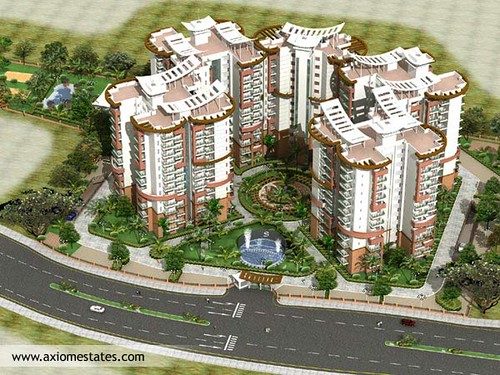
Image credit: Bangalore Properties - Real Estate India - Shriram Symphony by nancyarora2020 via flickr (BY-SA 2.0), sourced through Openverse.
Written by
Rajesh Tiwari
Real estate analyst covering property markets across Delhi NCR, Mumbai, and Bangalore. Rajesh tracks pricing trends, RERA compliance, and investment opportunities for residential and commercial buyers.
Looking for a technology partner?
From IT consulting to virtual office to custom software — eDarpan can help.
Continue reading
Premium Homes in NCR 2026: Buy for Living or Investing?
Is a premium NCR home a place to live or a store of value? A number-first guide to premiums, rental yields and resale liquidity before you buy.
Home Prices Outpacing Salaries: Should Indian Buyers Stop Waiting in 2026?
Home prices are outpacing salaries across Indian metros. Here's how to test whether buying now beats renting, using price-to-income ratios and a rent-vs-buy break-even.
Dwarka Flat or Dwarka Plot? Buyer Math for NCR Investors in 2026
Flat or plot in Dwarka? Hidden costs in GST, stamp duty and construction change the math. See how the answer shifts across 5, 10 and 15-year holds.