Data Centre Boom Reshapes Indian Real Estate: Where Buyers Win
India's data centre capacity is set to double, reshaping land demand. Here's where smart buyers can win in the corridors around hyperscale campuses.
Here's a problem that lands on my desk more often than you'd think: a property investor in Chennai or Pune sitting on a modest corpus, watching residential prices climb past what the yields justify, asking me where the smart money is actually moving. The honest answer for the last three years has been unglamorous — follow the servers. Not the flashy towers, not the sea-facing flats. The windowless, high-security sheds that hyperscalers and private equity are throwing thousands of crores at across a handful of Indian corridors.
The number that usually stops people mid-sentence: India's operational data centre capacity is on track to roughly double from around 1 GW to over 2 GW within the next two to three years, and that build-out is backed by tens of thousands of crores in committed capital from players like Blackstone, Brookfield, and the domestic majors. That capital doesn't hover in the abstract. It lands on specific plots, in specific talukas, near specific substations and subsea cable landing stations. And when it lands, it moves land prices, rental benchmarks, and the entire commercial ecosystem around it.
This post is about reading that map. I'll walk through why the data centre real estate India story is driving land demand in identifiable corridors, where the buyer opportunities sit (and where they've already been priced in), a worked example of how one investor played it, a corridor comparison table, and a checklist you can actually use before you commit rupees.
Key Takeaways
- Data centre demand is hyper-local — it clusters around power availability, fibre, and land parcels of 5+ acres, not around city glamour.
- The real buyer opportunity is rarely the DC plot itself (too big, too capital-heavy) but the peripheral real estate: worker housing, warehousing, commercial, and small industrial plots within 5–10 km.
- Mumbai (Navi Mumbai/Panvel), Chennai (Ambattur/Siruseri), Hyderabad, and now Noida/Greater Noida are the corridors seeing the sharpest land-value movement.
- Verify power sanction, land-use classification, and RERA/local approvals before you assume "DC nearby = guaranteed appreciation."
- Entry timing matters: get in when the land is acquired and announced but before the facility is commissioned — that's the appreciation window.
- Watch state DC policies (Tamil Nadu, Maharashtra, UP, Telangana all have specific incentives) — they signal where the next wave lands.
Why is data centre investment suddenly reshaping Indian land demand?
Three things converged. First, the Digital Personal Data Protection Act and broader data-localisation pressure mean more data has to physically sit inside India. Global companies can't just park Indian customer data in Singapore anymore without friction. Second, the AI wave has changed the maths — training and inference workloads are power-hungry, and every enterprise dabbling in AI needs compute somewhere. Third, cheap capital found a home: data centres offer PE funds long-dated, dollar-hedgeable, infrastructure-grade yields that residential and even office real estate struggle to match.
What this means on the ground is a scramble for a very specific kind of parcel. A hyperscale campus wants 10 to 50 acres, contiguous, with access to 100+ MW of power, redundant fibre, low flood risk, and reasonable proximity to a metro's enterprise cluster. Those parcels are not evenly distributed. When Brookfield or an NTT or a CtrlS locks up 30 acres in a taluka, the land within a few kilometres suddenly has a new anchor tenant class — and prices react.
I've watched this play out with clients who came to us for straightforward IT consulting and ended up asking about the property angle once they realised their own vendor's new facility was sitting next to land they could have bought two years earlier for a third of the price.
Which Indian corridors are seeing the sharpest data centre-led land movement?
Let me be specific, because vague "Tier-1 cities are booming" advice is useless when you're writing a cheque.
Mumbai — Navi Mumbai, Panvel, and Airoli
This is India's largest DC hub, full stop. The subsea cable landing stations at Versova and the power availability around Navi Mumbai make it the default choice for capacity. Land in and around the Rabale, Airoli, and Panvel belts has seen aggressive commercial interest. The catch: it's expensive and largely spoken for. Buyer opportunity here is in the ancillary commercial and residential rental market serving DC staff and adjacent IT parks.
Chennai — Ambattur, Siruseri, and the OMR belt
Chennai's second only to Mumbai for capacity, and it's got the cable landing advantage plus Tamil Nadu's fairly aggressive DC policy offering stamp duty and electricity duty concessions. The OMR (Old Mahabalipuram Road) corridor and areas near Siruseri SIPCOT are where I'd point a mid-budget investor looking at commercial or industrial-adjacent plots.
Hyderabad — Uppal, Shamshabad, and the ORR clusters
Telangana rolled out one of the earliest dedicated DC policies, and the results show. Land along the Outer Ring Road pockets has moved. If you want the fuller picture on whether Hyderabad's broader run has legs, we covered it in Hyderabad Property Boom 2026: Is It Sustainable or a Bubble? — worth reading before you assume DC demand alone justifies the residential prices.
Delhi-NCR — Noida and Greater Noida
This is the corridor I'd watch most closely right now for entry-stage opportunity. UP's data centre policy has pulled in serious commitments, and Greater Noida's plentiful land plus improving power infrastructure make it a genuine emerging hub rather than a mature one. Prices haven't fully caught up yet in the peripheral parcels. For the broader NCR developer dynamics, see Why Big Developers Are Piling Into Delhi-NCR: Buyer's View.
Data centre real estate India: which corridor fits which investor?
Here's how I frame the choice for clients, mapped against budget, risk appetite, and the type of parcel that's realistically buyable.
| Corridor | Maturity | Peripheral entry ticket (₹) | Appreciation stage | Best-fit buyer |
|---|---|---|---|---|
| Navi Mumbai / Panvel | Mature hub | ₹1.5 Cr+ for meaningful commercial | Late — mostly priced in | Rental-yield seekers, deep pockets |
| Chennai (OMR / Siruseri) | Established | ₹60L–₹1.2 Cr | Mid — selective upside left | Commercial-plot & rental investors |
| Hyderabad (ORR pockets) | Established | ₹50L–₹1 Cr | Mid — do your diligence | Balanced growth investors |
| Greater Noida | Emerging | ₹35L–₹80L | Early — best entry window | Higher risk-appetite, longer hold |
| Pune (Hinjewadi fringe) | Emerging | ₹40L–₹90L | Early-mid | Mid-budget diversifiers |
Treat those ticket ranges as directional, not gospel — micro-market variation within a single taluka can be enormous, and a plot with clear title and approved land-use commands a premium over one with encumbrances that you'll spend a year sorting out.
A worked example: how one investor played the Greater Noida DC wave
A client of ours — call him Rajeev, a 52-year-old business owner in Delhi with roughly ₹1.2 crore to deploy — came in wanting "something safer than the stock market but better than an FD." Standard brief. What made his case interesting is how we structured the DC-adjacent play instead of chasing a launch-day residential flat.
Here's what we did, step by step:
- Identified the anchor. A major operator had publicly announced land acquisition for a hyperscale campus in a Greater Noida industrial pocket. The facility wasn't built yet — that's the key. The announcement was ~14 months old; construction was underway.
- Mapped the 5 km radius. We looked at what a commissioned DC actually needs nearby: temporary and permanent worker accommodation, small service businesses, logistics/warehousing for equipment, and eventually office demand from vendors setting up support operations.
- Verified the fundamentals. Confirmed the land-use classification allowed the residential/commercial development he was considering, checked the plot's title chain, and confirmed power and road infrastructure were funded, not just planned.
- Bought a residential-plus-commercial plot in an approved layout about 4 km from the campus site for ₹78 lakh, with clear title and RERA-registered project status.
- Held through commissioning. As construction progressed and two additional operators announced parcels in the same belt, the micro-market re-rated.
Over about 26 months, the plot's assessed value rose meaningfully — not doubling, but a solid double-digit annualised move plus rental income once he built a small commercial unit that a support-services vendor leased. The point isn't the exact percentage; it's the mechanism. He didn't buy the data centre. He bought the ecosystem that a data centre inevitably pulls into existence.
Pro Tip: The appreciation window is between land acquisition announcement and facility commissioning, typically an 18–30 month gap. Buy after the announcement (so the anchor is confirmed) but before the buildings go up (so the surrounding land hasn't fully re-rated). Buying after commissioning usually means you're paying for growth that's already happened.
What must you verify before buying data centre-adjacent property?
This is where most first-time investors get burned. "There's a data centre coming nearby" is a story, not a guarantee. Run this checklist before you sign anything.
- Confirm the anchor is real and funded. A press release about "plans" is worthless. Look for actual land acquisition, environmental clearances, and preferably visible construction. Board resolutions and state incentive approvals are stronger signals than PR.
- Check land-use classification. Buying agricultural land expecting to build commercial without conversion (CLU) is a classic trap. Confirm the zoning permits your intended use.
- Verify title and encumbrances. Get a proper title search and encumbrance certificate. In peri-urban corridors, disputed titles are rampant.
- Confirm RERA registration if it's a project or layout. Our breakdown in RERA Escrow Rules 2026: How Buyers Verify a Project's Safety walks through exactly how to check whether your money is protected.
- Assess actual infrastructure timelines. Roads, water, and power for your parcel — not just the DC's dedicated feed. A DC gets priority power; the residential colony 3 km away might wait years.
- Budget for GST and stamp duty properly. Under-construction commercial attracts GST; stamp duty varies by state (and some DC-policy states offer concessions on industrial land specifically, not always on your adjacent residential plot). Model the full landed cost.
Common Mistake: Assuming the state's data centre incentive package applies to your purchase. Those stamp-duty and electricity-duty waivers are almost always ring-fenced for the DC operator's designated land, under specific investment and employment conditions. Your adjacent plot pays full duty. I've seen buyers factor in phantom savings and blow their return maths entirely.
How does eDarpan help you act on this — property and the tech behind it?
Two sides of the same coin, and we sit on both, which is unusual.
On the property side, our eDarpan Properties team tracks exactly these corridor movements. If you want to see live inventory in DC-adjacent belts, browse properties for sale in India or, if you're thinking rental-yield rather than capital gains, rental properties in India. We help filter for the fundamentals — title clarity, approved land-use, genuine infrastructure — rather than the launch-day hype.
On the technology side, the same forces driving DC demand are pushing Indian SMBs toward the cloud. If you're a business owner weighing whether to keep an on-prem server room or shift workloads to hyperscalers now sitting on Indian soil, our cloud migration and managed services team does exactly that assessment. Data localisation, latency, and cost all improve when your provider's capacity is physically in India — which is precisely why this build-out matters beyond real estate.
For NRIs eyeing these corridors from abroad, the tax and repatriation mechanics deserve their own read — start with NRI Property Investment in India 2026: Rules, Tax & Repatriation before wiring funds.
What's the downside risk, and how do you protect against it?
Let me not oversell this. Data centre demand is real, but a few honest cautions:
- Concentration risk. If a single announced project stalls or relocates, an entire micro-market's premise wobbles. Diversify your anchor thesis — corridors with multiple committed operators are safer than single-project bets.
- Liquidity. Peripheral industrial-adjacent plots can be slow to exit. Have a realistic 3–5 year hold horizon, not a flip mentality.
- Over-optimistic pricing. By the time a corridor is in every newspaper, the easy money is gone. See Delhi Property Cheapest Globally: Why It's a Buyer's Signal for how to think about relative value rather than momentum.
- Policy dependency. Much of this rests on state incentives and stable power tariffs. Policy shifts can change project economics.
Protect yourself the boring way: clean title, approved use, multiple anchors, realistic hold period, and a full landed-cost model including GST and duties. If you're an SMB owner, keep your business's own IT decisions separate from your property bets — talk to a consultant at eDarpan for either, but don't let one thesis distort the other.
Frequently Asked Questions
Is investing near a data centre in India actually profitable for small investors?
It can be, but rarely by buying the DC plot itself — those are large, capital-heavy parcels for institutions. Small investors profit from the peripheral ecosystem: residential rentals for staff, small commercial units for support vendors, and land in a 5–10 km radius bought before the facility is commissioned.
Which is the best city for data centre real estate in India right now?
For maturity and rental stability, Navi Mumbai and Chennai lead. For early-entry appreciation potential, Greater Noida is the corridor I'd watch most closely, followed by Pune's fringes, because prices there haven't fully absorbed the announced capacity yet.
Do state data centre incentives lower my stamp duty as an adjacent buyer?
Almost never. Those stamp-duty and electricity-duty concessions are ring-fenced for the operator's designated project land, tied to investment and employment commitments. Your adjacent residential or commercial plot pays full applicable stamp duty and GST.
How long should I plan to hold a data centre-adjacent property?
Plan for at least 3–5 years. The appreciation mechanism depends on the facility being built and the surrounding ecosystem maturing, which takes time. Treat these as growth-plus-yield holds, not quick flips.
What's the single biggest risk in this strategy?
Buying on an unconfirmed or single-project anchor. If that project stalls or relocates, the premise for your appreciation collapses. Prefer corridors with multiple committed operators and visible construction rather than a lone press release.
Does the data centre boom affect where my business should host its data?
Yes — with more hyperscale capacity physically in India, latency and data-localisation compliance both improve when you host domestically. Many SMBs can now migrate off costly on-prem servers to Indian-region cloud at lower total cost; our cloud services team assesses that on a case-by-case basis.
Can NRIs invest in data centre-adjacent property in India?
Yes, subject to FEMA rules — NRIs can freely buy residential and commercial property (not agricultural land) in India. The nuances of tax and repatriating your gains are what trip people up; read our NRI investment guide before committing funds.
The bottom line
The data centre real estate India story isn't a hype cycle you've missed — it's a multi-year, capital-backed structural shift that's still redrawing the map corridor by corridor. The winners won't be the ones chasing headlines. They'll be the buyers who read the anchor signals early, verify the boring fundamentals, and position in the ecosystem around the servers rather than trying to compete with Blackstone for the servers themselves.
If you want help identifying which specific parcels sit in a genuine DC-growth belt, or you're a business owner rethinking your own infrastructure in light of all this new domestic capacity, that's exactly the intersection eDarpan works at. Browse the properties platform, or reach out to the team and tell us your budget and horizon — we'll point you at the corridors that fit, and steer you away from the ones already priced for perfection.
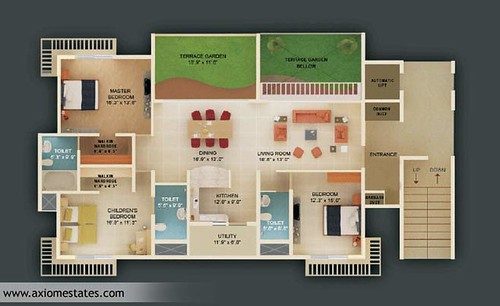
Image credit: Pune Properties - Real Estate India - Vascon Willows Floorplan by nancyarora2020 via flickr (BY-SA 2.0), sourced through Openverse.
Written by
Rajesh Tiwari
Real estate analyst covering property markets across Delhi NCR, Mumbai, and Bangalore. Rajesh tracks pricing trends, RERA compliance, and investment opportunities for residential and commercial buyers.
Looking for a technology partner?
From IT consulting to virtual office to custom software — eDarpan can help.
Continue reading
Real Estate Investment in India 2026: Where Big Money Is Going
Discover where institutional money is flowing in Indian real estate in 2026 — warehousing, Grade A offices, and data centres — and how to follow the trail.
India's Real Estate Transparency Rises 2026: What Buyers Gain
India entered the 'Transparent' tier at 26th globally in GRETI 2026. Here's what it means for buyers, plus a practical due-diligence checklist to avoid costly mistakes.
Rental Yields in Delhi-NCR 2026: Which Areas Pay Landlords
Discover which Delhi-NCR areas actually pay landlords in 2026. Compare gross vs net yields across Gurgaon, Noida & Ghaziabad micro-markets with real numbers.