India's AI Talent Gap: How SMBs Can Ship AI Without Hiring
Can't afford a ₹30L ML engineer? Learn how Indian SMBs ship voicebots, WhatsApp automation, and AI workflows for ₹15K-₹60K/month without hiring a team.
Last month a founder in Coimbatore told me he'd been trying to hire a machine learning engineer for seven months. He'd posted on Naukri, LinkedIn, referral networks, the works. The two candidates who actually cleared his technical round wanted ₹28 lakh and ₹32 lakh respectively. His entire annual tech budget was ₹40 lakh. He runs a 60-person textile export business doing about ₹22 crore in revenue, and he genuinely needed AI to handle his customer query load and automate order status updates. He just couldn't afford to build a team to do it.
That conversation is the whole story of the AI talent gap India SMB problem in one anecdote. NASSCOM's own estimates put the demand-supply gap for AI and data professionals in India somewhere north of half a million people, and the salaries for genuinely capable engineers have climbed to a point where a mid-market company in a tier-2 city simply can't compete with Bengaluru product firms or GCCs (global capability centres) throwing stock and ₹40L+ packages at fresh talent.
Here's the part nobody tells you: you almost certainly don't need to hire an AI engineer to ship AI. Most SMB AI use cases in 2026 (voicebots, WhatsApp automation, document processing, lead qualification) are solved by assembling existing platforms and partners, not by writing models from scratch. This post walks through exactly how to do that, with real numbers, a worked example, and a checklist you can hand to a vendor tomorrow.
Key Takeaways
- You don't need to hire scarce ML engineers. 80% of SMB AI use cases are configuration-and-integration problems, not research problems.
- A managed voicebot or WhatsApp automation deployment typically runs ₹15K–₹60K/month all-in, versus ₹25L+/year for a single in-house hire.
- Buy the platform, rent the expertise. Use a delivery partner for the 6-to-10-week build, then run it in-house with your existing ops team.
- Start with one narrow, high-volume, low-risk workflow (order status, appointment booking, first-line support) before touching anything revenue-critical.
- Budget for the boring parts: data cleanup, DPDP-compliant consent flows, and a human escalation path. These decide whether the project survives month three.
Why is the AI talent gap in India SMB hiring so brutal right now?
Three forces are squeezing at once. First, the GCC boom. Every multinational is standing up an India engineering centre, and they're hoovering up the exact profiles you want. Bengaluru, Hyderabad, Pune, and increasingly Gurugram and Chennai have become talent battlegrounds where a 3-year experienced ML engineer commands what a CTO earned a decade ago.
Second, the supply side is thin at the top. India produces a huge number of engineering graduates, but the fraction who can actually design a production RAG pipeline, fine-tune a model, or debug a hallucinating agent is small. Bootcamp certificates don't close that gap. The people who can are already employed and getting counter-offered.
Third, and this is the one founders underestimate, even if you hire someone, a single engineer can't run production AI alone. You need MLOps, prompt engineering, integration work, and ongoing monitoring. One hire becomes three hires becomes a team, and now you're running an AI department to send WhatsApp order updates. That's the trap.
The counterintuitive conclusion: the talent gap is real, but for most SMBs it's the wrong problem to solve. You're not building a foundation model. You're deploying one that already exists.
What AI can SMBs actually deploy without an in-house team?
Let me be specific about what's genuinely buy-and-configure versus what still needs deep engineering. If your use case is in the first column, you can ship it in weeks without a full-time AI hire.
| Use case | Buildable without an AI hire? | Typical approach | Rough monthly cost |
|---|---|---|---|
| Customer support voicebot (order status, FAQs) | Yes | Managed voicebot platform + telephony | ₹18K–₹50K |
| WhatsApp order updates & lead qualification | Yes | WhatsApp Business API + automation flow | ₹8K–₹30K + message fees |
| Invoice / GST document extraction | Yes | Document AI API + light integration | ₹10K–₹40K |
| Internal knowledge assistant (policy, SOPs) | Mostly | RAG on Copilot/Gemini or a vendor build | ₹15K–₹45K |
| Custom demand-forecasting model on your data | No (needs specialist) | Data science engagement or hire | Project-based, ₹5L+ |
Notice the pattern. The things that scare founders (voicebots, chat automation, document AI) are the mature, productised categories. The thing they assume is easy (a bespoke forecasting model) is the one that actually needs the expensive talent. If your first AI project is in row five, stop and rethink your priorities. Start with rows one to four.
For a deeper cut on sequencing, I've written before about what SMBs should automate first in 2026. The short version: pick the workflow that's high volume, rule-heavy, and low-stakes if it occasionally gets something wrong.
The no-hire playbook: buy the platform, rent the expertise
Here's the model I recommend to almost every mid-market client. Split your AI project into two distinct cost buckets: the platform (a recurring subscription you pay forever) and the build (a one-time or short-term engagement to set it up). You own neither the model nor the engineers permanently. You rent both.
- Pick the platform based on your channel, not the hype. If your customers call, you need a voicebot platform. If they message, you need WhatsApp Business API automation. Don't buy an "AI platform" that promises everything.
- Engage a delivery partner for a fixed-scope build. This is a 6-to-10 week engagement, not a permanent team. They handle integration with your CRM/ERP, design the conversation flows, wire up telephony or WhatsApp, and set up escalation to your humans.
- Train your existing ops team to run it. Once deployed, updating an FAQ or tweaking a flow is a low-code, business-user task. Your customer support lead can own it. No engineer required for day-two operations.
- Keep a retainer for changes, not a headcount. A few hours a month of partner time (₹15K–₹30K retainer) covers new features and model updates. Cheaper and lower-risk than a hire.
Pro Tip: Negotiate your build contract so that you own the conversation flows, prompts, and integration configuration as deliverables, in writing. I've seen SMBs get locked into a partner because the "AI logic" lived in the vendor's proprietary console with no export. Ask for the flow definitions and prompt templates as exportable assets before you sign. This one clause has saved my clients lakhs in switching costs.
Worked example: a Jaipur clinic chain that shipped a voicebot in 7 weeks
A friend runs a diagnostics and clinic chain across Jaipur and Ajmer, six locations, about 90 staff. Their front desks were drowning. Roughly 1,400 inbound calls a day, mostly the same four questions: report status, timings, test prices, and appointment booking. They were losing calls during peak hours, and patients were walking to competitors because nobody picked up.
The instinct was to hire two more receptionists per branch (twelve people at roughly ₹18K/month each = ₹2.16L/month) or hire a "chatbot developer." Instead, here's what we actually did.
- Week 1–2: mapped the call data. We pulled two weeks of call logs and found 71% of calls were four intents. That's the entire business case. A bot that handles those four confidently deflects most of the volume.
- Week 2–3: chose the stack. A managed AI voicebot handling Hindi and English code-mixing (critical in Rajasthan, where patients switch mid-sentence), connected to their existing lab information system via API for real-time report status.
- Week 3–5: built the flows. Report status pulled live data. Price and timing queries answered instantly. Appointment booking wrote directly into their scheduling tool. Anything the bot couldn't handle escalated to a human queue with full context.
- Week 5–6: DPDP and consent. Since the bot reads report status tied to a patient, we added phone-number-plus-OTP verification before disclosing any health info, and a clear consent line at call start. Health data is sensitive; we did not cut corners here.
- Week 7: soft launch on two branches, then rolled out.
The numbers after two months: the bot handled about 62% of inbound volume end-to-end. All-in cost was around ₹42K/month (platform + telephony + a small retainer). No new hires. The two existing receptionists per branch went from firefighting to actually helping walk-in patients. Missed-call rate at peak dropped from roughly 30% to under 5%.
The lesson isn't "voicebots are magic." It's that a narrow, data-informed scope plus a managed platform plus a short partner engagement beat both the "hire more people" and the "hire an engineer" options on cost and speed. If you're weighing this against your old phone tree, the tradeoffs are laid out in AI voicebots vs IVR.
How much does no-hire AI actually cost versus building a team?
Let's put honest rupee figures on the table, because this is where the decision gets made. Assume you want to automate customer support across voice and WhatsApp.
| Approach | Year 1 cost | Time to live | Ongoing risk |
|---|---|---|---|
| Hire one ML/AI engineer | ₹22L–₹35L (salary + tools + hiring cost) | 3–7 months to hire, then months to build | Attrition, single point of failure |
| Build a small AI team (3 people) | ₹60L+ | 6+ months | High burn, overkill for SMB scope |
| Managed platform + delivery partner | ₹4L–₹8L (build + ~10 months platform) | 6–10 weeks | Vendor lock-in (manageable with the right contract) |
| Off-the-shelf SaaS bot, self-configured | ₹1.5L–₹4L | 2–4 weeks | Limited integration, generic answers |
For most SMBs, the third row is the sweet spot. You get real integration with your systems and someone accountable for delivery, without the fixed cost and attrition risk of a hire. The fourth row works if your needs are truly generic, but the moment you need it to read your ERP or verify an order, you'll outgrow it.
Common Mistake: Founders compare the ₹42K/month managed cost to a receptionist's ₹18K salary and conclude the bot is "expensive." Wrong comparison. Compare it to the revenue you're losing from dropped calls and slow responses, plus the fact that the bot works 24/7 across every festival and Sunday when your staff doesn't. Frame the ROI against lost business, not against a single salary.
Choosing the right partner (and not getting burned)
Since the no-hire model leans on a delivery partner, the partner choice is the whole game. Here's the checklist I use when vetting one for a client. Bring this to your first call.
- Do they have Indian deployments in your sector? Ask for two references you can actually call. Healthcare, logistics, retail, and education all have quirks. Sector experience shortens the build.
- Do they handle language properly? Hindi-English code-switching, Tamil, Marathi, Bengali. A bot that only does clean English will fail in a Nagpur or Madurai call centre. Test this live.
- Who owns the IP? Flows, prompts, and integration config should be your deliverables. Get it in writing.
- Is there a human escalation path by design? Any partner who says the bot handles "100%" is lying. You want graceful handoff with context.
- Do they understand DPDP consent and data residency? Especially if you handle health, financial, or personal data. This is now law, not a nice-to-have.
- What's the day-two model? Can your non-technical team make changes, or are you back to raising a ticket for every FAQ edit?
This is exactly the kind of scoping and vendor-management work our IT consulting practice does for SMBs who don't have a CTO to run the process. We've also written a practical guide to choosing an LLM provider beyond the benchmark charts if you want to understand what's under the hood.
Governance: the boring stuff that keeps you out of trouble
Two things quietly kill SMB AI projects, and neither is technical. The first is data governance. Under India's Digital Personal Data Protection Act, if your bot processes personal data (a phone number tied to an order is personal data), you need lawful consent, a clear purpose, and a way to honour deletion requests. Bake this into the design, not as an afterthought. For a health or financial bot, verify identity before disclosing anything.
The second is shadow AI. Your team is already pasting customer data into free chatbots to draft replies. That's a leak waiting to happen. Before you deploy anything official, roll out a basic usage policy. We covered a ready-to-use one in this piece on shadow AI policy that founders can implement in a week.
On the productivity side, if your knowledge-assistant use case sits inside your office suite, you may not need a custom build at all. Microsoft 365 with Copilot or Google Workspace with Gemini can cover a lot of internal Q&A ground. We compared them in Copilot vs Gemini for business so you can pick without a pilot.
A 30-day action plan to ship your first AI workflow
If you've read this far, you probably have a use case in mind. Here's how to move from idea to live in about a month, no hire required.
- Days 1–5: Pick one workflow and pull the data. Choose the highest-volume, most repetitive interaction. Export a week or two of call logs, chat transcripts, or ticket data. Count the top intents. If four or five intents cover 60%+ of volume, you have a strong candidate.
- Days 6–10: Define scope and success metrics. Write down exactly what the bot will and won't do, and the number you'll judge it by (deflection rate, missed-call rate, response time). Keep the "won't do" list honest.
- Days 11–15: Shortlist two or three partners or platforms. Run them against the vetting checklist above. Ask for a live demo in your actual languages.
- Days 16–30: Build, test on one team or branch, then roll out. Insist on a soft launch. Watch the escalations closely in week one; that's where you find the gaps.
Once the first workflow is stable and proving ROI, the second one takes half the time because you've built the muscle. This compounding is the real reason the no-hire model wins: you learn to ship AI as an operational habit, not a heroic project.
Where eDarpan fits
We built our services specifically around this no-hire reality for Indian SMBs. Whether it's an AI voicebot, WhatsApp Business API automation, bulk SMS for transactional alerts, or custom software and mobile apps to tie it all together, we do the fixed-scope build and hand you a system your own team can run. If you're also setting up or expanding a business entity, we help with virtual office addresses for GST and company registration too. And if you want to think through your roadmap before committing to anything, get in touch for a scoping conversation.
Frequently asked questions
Do I need to hire an AI engineer to build a voicebot for my business?
No. Voicebots for standard use cases like order status, appointment booking, and FAQs are built on mature managed platforms that require configuration and integration, not model development. A delivery partner can build it in 6–10 weeks and your existing ops team can run it afterward.
How much does an AI voicebot cost per month for an Indian SMB?
All-in costs typically range from ₹18K to ₹50K per month depending on call volume, languages, and integration depth. This includes the platform subscription, telephony charges, and a small support retainer. It's usually far cheaper than the lost revenue from missed calls or the salary of a single AI hire.
Is my customer data safe if I use a third-party AI platform?
It can be, if you insist on the right controls. Ensure your provider supports India's DPDP Act requirements including consent capture, purpose limitation, and deletion, and confirm where data is stored. For sensitive sectors like healthcare or finance, add identity verification before the bot discloses any personal information.
What's the difference between an off-the-shelf chatbot and a partner-built one?
Off-the-shelf SaaS bots are cheap and fast to deploy but give generic answers and struggle to connect to your ERP, CRM, or scheduling systems. A partner-built solution integrates with your actual data so the bot can pull real order status or write bookings back into your tools. Choose off-the-shelf for generic queries, partner-built when you need live system access.
Which AI use case should an SMB automate first?
Start with the workflow that is high volume, rule-heavy, and low-risk if it occasionally errs. First-line customer support, order and report status, and appointment booking are ideal starting points. Avoid making your first project a custom predictive model, which genuinely requires specialist talent.
Can my existing staff manage an AI system without technical skills?
Yes, for day-to-day changes. Modern platforms let a business user update FAQs, tweak conversation flows, and adjust responses through low-code interfaces. Keep a small retainer with your delivery partner for bigger changes and model updates rather than adding a permanent technical hire.
How do I avoid getting locked into an AI vendor?
Negotiate ownership of your conversation flows, prompts, and integration configuration as written deliverables before you sign. Confirm you can export these assets. This protects you if you ever want to switch providers and prevents your business logic from being trapped in a proprietary console.
The AI talent gap India SMB founders face is real, but it's a hiring problem, and you can sidestep it entirely by treating AI as something you deploy rather than something you build from scratch. Pick one narrow workflow, buy a proven platform, rent a partner for the short build, and run it with the team you already have. That's how a 60-person textile exporter in Coimbatore or a clinic chain in Jaipur ships production AI in weeks, while their bigger competitors are still interviewing candidates they can't afford.
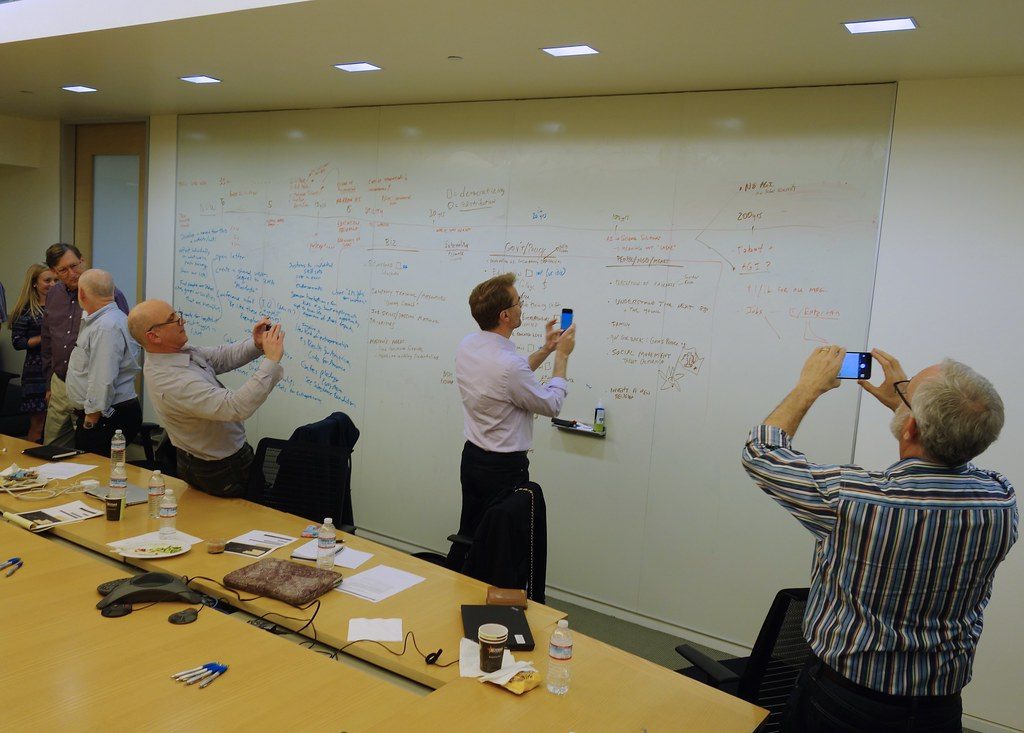
Image credit: Reflections on the new Machine Age — technology, inequality and the economy by jurvetson via flickr (BY 2.0), sourced through Openverse.
Written by
Meera Nair
IT project manager with a decade of experience delivering custom software and mobile apps for Indian businesses. Meera writes about technology adoption, app development lifecycles, and AI integration.
Looking for a technology partner?
From IT consulting to virtual office to custom software — eDarpan can help.
Continue reading
AI Voicebots for Indian SMBs 2026: Cut Call Wait, Not Staff
Indian SMBs lose 25-40% of calls after hours. See how an AI voicebot captures missed bookings in Hindi & regional languages—with real rupee costs.
AI Agents in Google Workspace & Microsoft 365 2026: Govern Safely
Deploy Gemini and Copilot without leaking client data or breaking DPDP compliance. A practical governance checklist and rollout guide for Indian SMBs in 2026.
AI Skilling for Indian SMB Teams 2026: Upskill Without Layoffs
Thinking of firing staff for AI-native hires? A practical 90-day plan for AI skilling for Indian SMBs that upskills your existing team 60-80% cheaper.