AI Tools for Indian E-Commerce Sellers: What Actually Works
Discover which AI tools actually work for Indian e-commerce sellers, from WhatsApp bots to voicebots, with real rupee budgets and no hype.
Last Diwali, a saree seller in Surat told me she'd hired three extra people just to answer WhatsApp messages during the festive rush. "Do you have this in green?" "Kab tak deliver hoga?" "COD available hai?" The same fifty questions, all day, across 2,000 orders. By January she'd let two of them go, not because sales dropped, but because a WhatsApp bot was handling 70% of those queries automatically. Her cost per resolved query fell from roughly ₹22 to under ₹3.
That's the real story with AI tools for ecommerce India right now. It isn't about replacing your team with some sci-fi robot. It's about killing the repetitive drudgery that eats your margins: writing 500 product descriptions, answering the same shipping question at 11 PM, chasing abandoned carts, translating listings into Hindi and Tamil. India crossed 190 million online shoppers in 2024, and most of them shop from their phones, in regional languages, expecting instant replies. If you're selling on Amazon, Flipkart, Meesho, or your own Shopify store, the sellers pulling ahead aren't the ones with the biggest ad budgets. They're the ones who've quietly automated the boring 80%.
This post walks through exactly which AI tools actually earn their keep for Indian sellers, where an AI voicebot and the WhatsApp Business API fit into your stack, what they cost in rupees, and the mistakes I've watched sellers make when they buy tools they don't need. No hype. Just what works.
Key Takeaways
- Start with the highest-volume, lowest-value work: catalog copy, image editing, and repetitive customer queries. That's where AI pays back fastest.
- WhatsApp is where Indian buyers actually talk to you. A properly set up WhatsApp Business API with a bot can handle 60-70% of queries and recover abandoned carts automatically.
- An AI voicebot makes sense once your call volume crosses roughly 100-150 calls a day, especially for COD confirmations and delivery updates in regional languages.
- Budget realistically: a solid AI stack for a small seller runs ₹8,000-25,000/month, far less than one extra support hire.
- Don't buy 10 tools. Pick 3-4 that connect to each other. Integration matters more than features.
- Keep humans in the loop for complaints, refunds, and anything emotional. Bots handle routine; people handle upset.
Which AI tools should Indian e-commerce sellers actually buy first?
The instinct is to buy everything. Don't. In eight years of setting up systems for sellers across Surat, Jaipur, and Bengaluru, I've learned the sequence matters more than the tools.
Here's the order that works, based on return on effort:
- Catalog and content automation first. This is pure time saved, no customer risk. AI writes your descriptions, generates variations for marketplaces, and cleans up product images.
- Customer support automation next, starting with WhatsApp. This directly reduces headcount and response time.
- Marketing automation third: abandoned cart recovery, personalised offers, review requests.
- Voice automation last, once your call volume justifies it.
Notice what's missing: no "AI-powered analytics dashboard" at the top, no fancy demand-forecasting engine. Those are nice for a ₹5 crore business. For most sellers doing ₹20 lakh to ₹2 crore a year, they're a distraction. Fix the daily grind first.
Catalog and content: your fastest win
Writing product listings is where most sellers waste the most hours. A single well-optimised Amazon listing with title, five bullet points, and a description takes a good copywriter 20-30 minutes. If you have 300 SKUs, that's over 100 hours of work.
Tools like ChatGPT, Claude, and Google's Gemini handle this in seconds. Feed them your product specs and a few examples of your brand voice, and they'll draft listings, generate SEO keywords, and even produce Hindi or Tamil versions. If you're weighing which assistant to standardise on, our breakdown of Claude vs ChatGPT for Indian SMBs covers the trade-offs for exactly this kind of work.
For images, tools like Photoroom and Canva's AI features remove backgrounds, generate lifestyle shots, and resize for every marketplace's spec at once. A ₹399/month Canva Pro subscription replaces what used to cost ₹150-300 per image at a design studio.
Pro Tip: Don't let AI publish listings unedited. Marketplaces like Amazon flag generic AI copy, and buyers can smell it. Use AI to draft, then spend 3 minutes editing each listing to add a real detail only you know, like "the stitching survives Indian monsoon washing." That one human touch is what converts.
How does WhatsApp Business API fit into an Indian seller's AI stack?
If there's one place to spend money, it's here. In India, WhatsApp isn't a support channel. It's the channel. Buyers who won't answer a call or read an email will reply to a WhatsApp message within minutes.
The free WhatsApp Business app is fine when you're doing 20 orders a day. Once you cross 50-100, you need the WhatsApp Business API, which lets you connect a bot, send bulk notifications, and handle multiple agents on one number. This is where automation and human support live together.
A well-built WhatsApp flow handles:
- Order confirmations and shipping updates, sent automatically with tracking links.
- Common questions answered instantly: sizing, availability, COD, return policy.
- Abandoned cart nudges: "You left the blue kurta in your cart. Complete your order and get free shipping today."
- Review and feedback collection after delivery.
- Seamless handoff to a human agent when the bot hits something it can't handle.
One thing sellers underestimate: the WhatsApp API is billed per conversation, not per message, and Meta changed its pricing model in 2024-25. Utility conversations (order updates) and marketing conversations are priced differently. Marketing templates cost roughly ₹0.70-0.80 per conversation in India, while service replies within a 24-hour customer-initiated window are often free. Your provider handles the setup, template approvals, and green tick verification. eDarpan sets up the API, bot flows, and template approvals as part of the WhatsApp Business API service, so you don't fight with Meta's approval process alone.
Don't forget SMS for the moments WhatsApp can't reach
WhatsApp is dominant, but not universal. Some older customers, some Tier-3 buyers, and critical OTP or delivery-failure alerts still need SMS as a fallback. A layered approach, WhatsApp first with bulk SMS services as backup, catches everyone. SMS also works when a customer's WhatsApp template gets blocked or their number isn't on WhatsApp.
When does an AI voicebot make sense for online sellers?
Voice is the last piece, and the most misunderstood. Sellers see an AI voicebot demo, get excited, and buy it before they need it. Here's the honest threshold: if you're getting fewer than 80-100 calls a day, a voicebot is overkill. Your team can handle it.
But once you cross that line, especially during festive spikes, voice automation transforms your operations. The biggest use case in Indian e-commerce isn't inbound support. It's outbound COD confirmation.
Return-to-origin (RTO) is the silent killer of Indian e-commerce margins. When a COD order gets refused at the door, you eat forward and reverse shipping, roughly ₹100-160 per failed delivery. Confirming COD orders before dispatch cuts RTO significantly. An AI voicebot can call every COD customer within an hour of ordering, in Hindi, Marathi, or Tamil, confirm the address and intent, and flag doubtful orders for review.
A voicebot handling 500 confirmation calls a day at, say, ₹2-4 per call is roughly ₹30,000-60,000/month. If it cuts your RTO rate from 25% to 15% on 500 orders a day, you're saving lakhs. The math is genuinely compelling at scale.
Common Mistake: Sellers deploy a voicebot that sounds robotic and speaks only English, then wonder why customers hang up. In India, the voicebot must speak the customer's language and sound natural. Insist on a Hindi and regional-language voicebot with proper local accents. Test it with your own customers before going live, not in a boardroom demo.
AI tools for ecommerce India: a real comparison of what to run
Let me lay out the actual stack I'd recommend for a mid-sized Indian seller, with real rupee costs. This is the comparison sellers ask me for most.
| Layer | Tool / Option | What it does | Approx. monthly cost (₹) | When you need it |
|---|---|---|---|---|
| Content & catalog | ChatGPT Plus / Claude Pro | Listing copy, translations, ad text | 1,600-1,800 | Day one, any seller |
| Images | Canva Pro / Photoroom | Background removal, marketplace resizing | 400-800 | Day one |
| Customer support | WhatsApp Business API + bot | Auto-replies, order updates, cart recovery | 5,000-15,000 (incl. conversation fees) | Above ~50 orders/day |
| Fallback messaging | Bulk SMS | OTP, delivery alerts, non-WhatsApp reach | 1,000-5,000 (usage-based) | Alongside WhatsApp |
| Voice automation | AI voicebot | COD confirmation, delivery follow-up | 25,000-60,000 | Above ~100 calls/day |
A small seller doing ₹20-40 lakh a year can run the top three layers for around ₹8,000-18,000/month. That's less than half the fully-loaded cost of one support hire, and it works 24 hours a day. For deciding between the big AI suites for your team's day-to-day work, our comparison of Gemini Enterprise vs Copilot for Indian SMBs is worth a read.
Case study: how a Jaipur home-decor seller cut support costs by 60%
Let me walk through a real setup, with the numbers changed slightly for privacy. A home-decor seller in Jaipur, selling handmade lamps and cushions across their own Shopify store and Amazon, was doing about 1,200 orders a month. They had two full-time support staff at ₹18,000 each, plus the owner answering WhatsApp late into the night.
Their problems were textbook:
- Support staff spent most of their day on "where is my order?" queries.
- COD RTO was running at 28%, brutal on fragile handmade goods.
- Cart abandonment on Shopify was around 70%, with no recovery system.
Here's what we built over about three weeks:
- WhatsApp Business API setup (Week 1): Got the number verified with Meta, applied for the green tick, and connected it to their Shopify and Amazon order data. We built a bot flow that automatically sent order confirmations and shipping updates with tracking links.
- FAQ bot and human handoff (Week 2): Trained the bot on their top 40 questions: return policy, materials, cleaning, delivery timelines. Anything the bot couldn't answer routed to a human within the WhatsApp inbox, so no customer was ever stuck.
- Abandoned cart recovery (Week 2): Set up automatic WhatsApp nudges 2 hours and 24 hours after cart abandonment, with a small free-shipping incentive on the second message.
- AI voicebot for COD confirmation (Week 3): Deployed a Hindi-language voicebot that called every COD order within 90 minutes. Confirmed orders proceeded; unconfirmed ones after two attempts were held for manual review.
The results after 90 days:
- The bot handled about 65% of all queries without human intervention.
- They moved one support person to a growth and listings role instead of hiring a third.
- COD RTO dropped from 28% to 17%, saving roughly ₹1.3 lakh a month in wasted shipping.
- Recovered carts added about 9% to monthly revenue.
Total monthly tool cost, including the voicebot, was around ₹42,000. Against savings and recovered revenue well past ₹2 lakh, the payback was immediate. The build itself was a straightforward integration project, the kind of work our custom software development and IT consulting teams handle for sellers regularly.
What about compliance, data, and the boring-but-important stuff?
This is where I see sellers get burned later. A few things to get right from the start:
GST and invoicing. If you're selling on marketplaces, your GST registration and invoicing need to be clean. Automate GST-compliant invoice generation from your order system rather than doing it manually. If you're just formalising your business or need a registered address for GST across states, a virtual office address for GST and company registration is a legitimate, cost-effective route that many online sellers use.
Data and the DPDP Act. India's Digital Personal Data Protection Act is now in force, and it applies to you. When your WhatsApp bot and voicebot handle customer phone numbers, addresses, and order history, you're processing personal data. Get consent for marketing messages, keep data with reputable providers, and don't dump customer lists into random AI tools. Meta's WhatsApp templates already require opt-in for marketing, which helps.
Vendor lock-in. Build your automation so your customer data lives in your systems, not trapped inside a bot vendor's platform. If you switch providers, you should be able to export everything.
Pro Tip: Keep your product and communication apps consistent with your back office. Running your team on Google Workspace or Microsoft 365 for shared inboxes, order sheets, and documents makes integrating AI tools far cleaner than a patchwork of free accounts. Integration headaches are almost always the real cost, not licences.
Where to start if you're doing this yourself
If you want to move without waiting for a vendor, here's a two-week self-start plan:
- Days 1-3: Sign up for one AI writing assistant. Rewrite your 20 best-selling product listings. Measure whether conversion improves.
- Days 4-6: Batch-clean your product images with a background-removal tool. Standardise them across marketplaces.
- Days 7-10: Move to the WhatsApp Business API. Get verified, set up order-confirmation and shipping templates first (these are the easiest to approve and highest value).
- Days 11-14: Add your top 30 FAQ answers to the bot and set up abandoned-cart recovery. Leave voice for later.
You'll notice voice comes only when volume demands it. Resist buying it early. And if any of this feels like more than you want to manage while running the actual business, that's exactly the kind of project eDarpan scopes and builds end to end. Our full services overview covers the messaging, automation, and cloud pieces, and if you'd rather talk it through first, reach out to the team for a straight assessment of what your volume actually needs.
Frequently asked questions
What are the best AI tools for e-commerce sellers in India?
For most Indian sellers, the core stack is an AI writing assistant like ChatGPT or Claude for listings, an image tool like Canva or Photoroom, and the WhatsApp Business API with a bot for customer support and cart recovery. Add an AI voicebot only once your daily call volume crosses roughly 100 calls. Start with content and support before anything fancy.
How much does a WhatsApp chatbot cost for an Indian online store?
Expect ₹5,000-15,000 per month for a small to mid-sized seller, including platform fees and Meta's per-conversation charges. Marketing conversations cost roughly ₹0.70-0.80 each in India, while service replies within a 24-hour window are often free. The bigger cost is a one-time setup and integration, which a provider typically handles for you.
Can an AI voicebot speak Hindi and regional Indian languages?
Yes. A good AI voicebot supports Hindi, Marathi, Tamil, Telugu, Bengali, and more, with natural local accents. This is essential for Indian e-commerce, especially for COD confirmation calls where customers respond far better in their own language. Always test the voice quality with real customers before going live.
Will AI-generated product descriptions hurt my Amazon or Flipkart rankings?
Not if you edit them. Marketplaces can flag generic, unedited AI copy, and identical descriptions across sellers perform poorly. Use AI to draft, then add specific real-world details and your brand voice. Human-edited AI content ranks and converts well; raw AI dumps do not.
Is it legal to send marketing messages on WhatsApp to my customers in India?
Yes, provided you have opt-in consent, which Meta's WhatsApp Business API requires for marketing templates. Under India's DPDP Act, you also need clear consent to process and use customer personal data for marketing. Keep records of consent and provide an easy opt-out to stay compliant.
Do I need custom software or can I use off-the-shelf AI tools?
Most sellers can start with off-the-shelf tools and no-code integrations. You need custom software development only when you're connecting multiple systems, like syncing Shopify, Amazon, your WhatsApp bot, and a voicebot into one workflow, or building logic that off-the-shelf tools can't handle. Start simple and build custom only where it pays back.
Which AI agents should Indian SMBs deploy first?
Deploy agents on high-volume, low-risk tasks first: customer FAQ handling, order-status queries, and abandoned-cart follow-up. Our guide on where to deploy AI agents first goes deeper, but the principle is simple: automate the repetitive routine and keep humans on complaints and refunds.
The bottom line
The sellers winning in Indian e-commerce right now aren't chasing every shiny tool. They've automated the boring, repetitive 80% of their work and freed their people for the 20% that actually needs a human. The right AI tools for ecommerce India are the ones that quietly cut your RTO, answer your customers at midnight in their own language, and recover carts you'd otherwise lose, all for less than the cost of one extra hire.
Start with content and catalog. Add WhatsApp automation when your orders cross fifty a day. Layer in an AI voicebot only when your call volume justifies it. Keep your data in your own systems, stay clean on GST and DPDP, and edit anything AI produces before it reaches a customer. Do that, and you'll spend less, sell more, and stop drowning in the same fifty questions every single day.
If you'd like help mapping this to your specific volume and marketplaces, talk to eDarpan. We'll tell you honestly what you need now and what can wait.
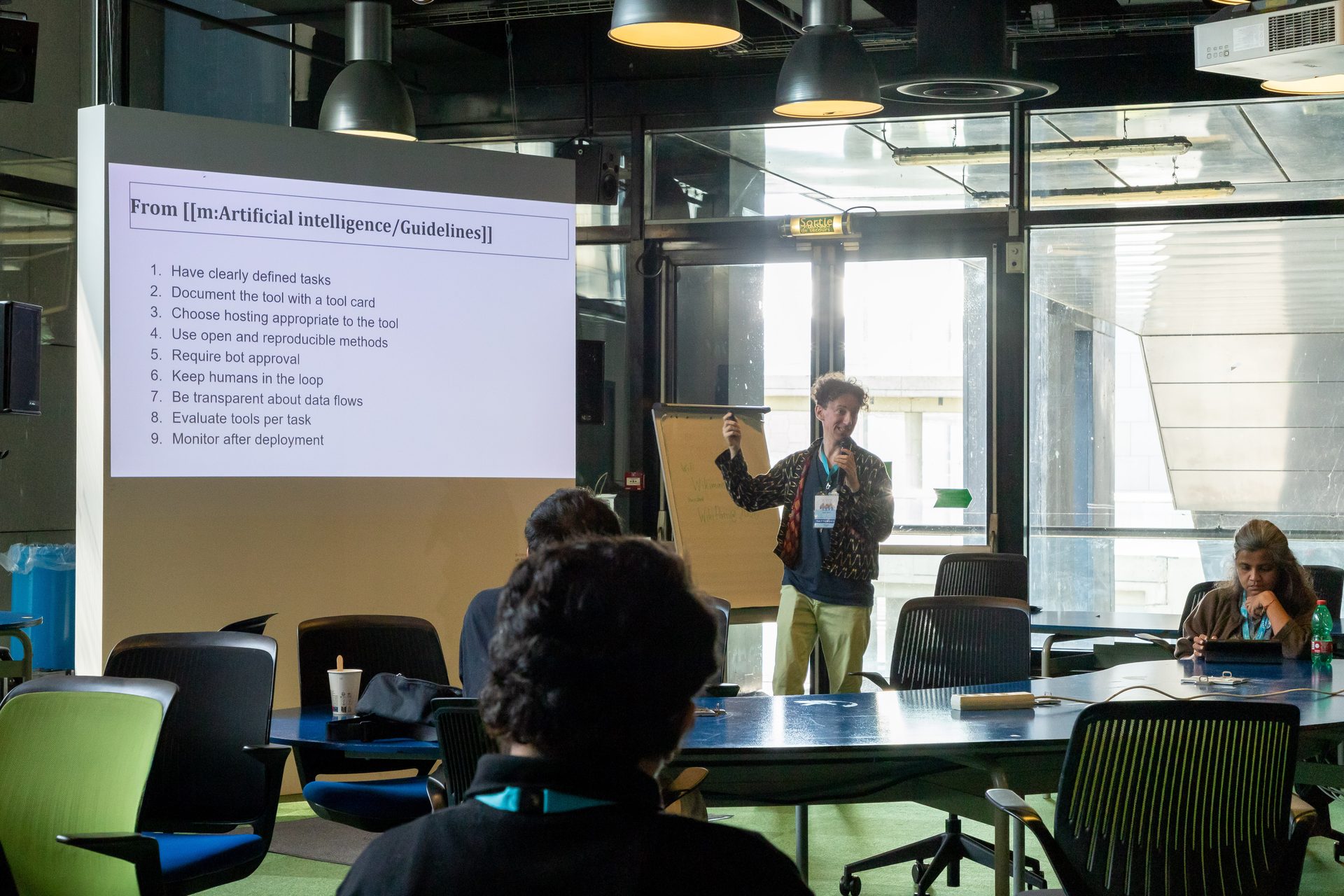
Image credit: AI, Automation, and Human Judgment panel 08 by Guillermo Carlos Gómez via wikimedia (BY-SA 4.0), sourced through Openverse.
Written by
Meera Nair
IT project manager with a decade of experience delivering custom software and mobile apps for Indian businesses. Meera writes about technology adoption, app development lifecycles, and AI integration.
Looking for a technology partner?
From IT consulting to virtual office to custom software — eDarpan can help.
Continue reading
AI Agents in Google Workspace & Microsoft 365 2026: Govern Safely
Deploy Gemini and Copilot without leaking client data or breaking DPDP compliance. A practical governance checklist and rollout guide for Indian SMBs in 2026.

AI Skilling for Indian SMB Teams 2026: Upskill Without Layoffs
Thinking of firing staff for AI-native hires? A practical 90-day plan for AI skilling for Indian SMBs that upskills your existing team 60-80% cheaper.
AI Voicebots for Indian SMBs 2026: Cut Call Costs, Not Service
Missed calls cost Indian SMBs lakhs a year. See how an AI voicebot cuts call costs, handles bookings 24/7 in Hindi and English, and delivers real ROI in 2026.