Sovereign Cloud vs Global Clouds: Data Localisation Costs for SMBs
Data localisation rules are reshaping cloud decisions for Indian SMBs. Here is what in-region and sovereign hosting really cost, where hidden expenses sit, and how to decide.
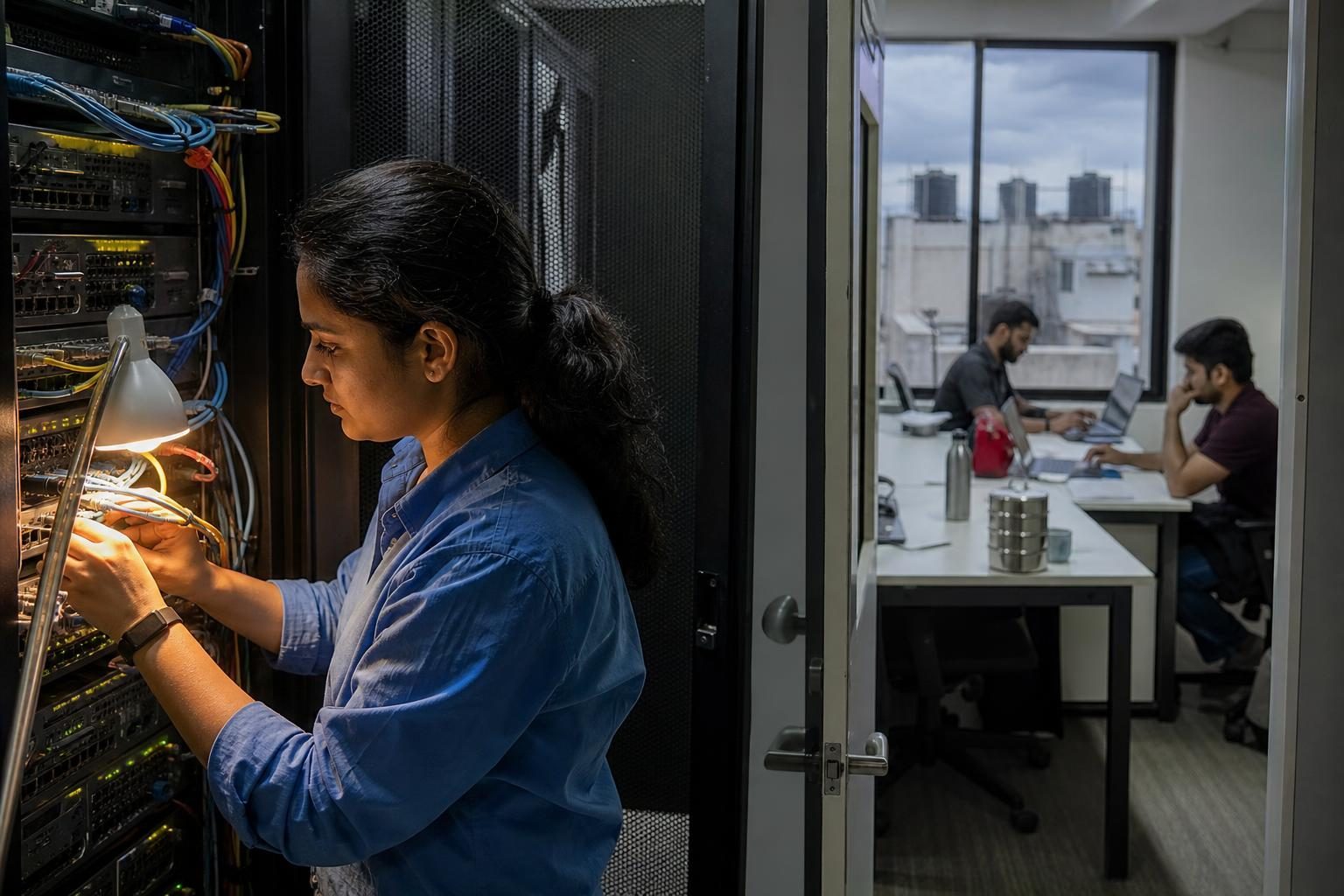
Last year a Pune-based ed-tech startup with 22 employees learned the hard way that a single line in a government tender can rewrite its entire infrastructure plan. The tender asked that student records stay within Indian borders. Their workloads sat in a US region of a global hyperscaler, cheap and well understood, and suddenly the team was scrambling to figure out what "in India" actually meant, what it would cost, and whether they had three months or three weeks. That scramble is becoming common. Founders who once picked a cloud region for latency and price now face questions about sovereign cloud India SMB data localisation cost, and the answers are rarely as simple as a rate card comparison. This post is for founders, CTOs, and the one person who doubles as IT admin at a 40-person company. I will walk through what data localisation actually requires under current Indian rules, what sovereign and in-region options cost in practice, where the hidden expenses hide, and how to decide. You will find a worked example, a comparison table, a migration sequence you can hand to a vendor, and a few mistakes I have seen cost real money.
Why Data Localisation Suddenly Matters for Indian SMBs
For years, most Indian SMBs treated cloud location as an engineering decision. Pick the nearest region with low latency, check the price, move on. That logic still holds for many workloads. But the compliance surface has widened. The Digital Personal Data Protection Act, 2023 and its rules framework give the government power to restrict cross-border transfers to notified countries, and sector regulators have their own expectations. RBI rules on payment data have required storage within India for years. The CERT-In directions of 2022 require log retention and incident reporting timelines that are easier to meet when logs and systems sit close to home. Government procurement increasingly carries data residency clauses, which matters if you sell to any ministry, PSU, state agency, or large enterprise that inherits those obligations.
The practical effect is that your question is no longer "where is the cheapest region?" It is "which of my data must stay in India, which can travel, and what does each answer cost me?" Some businesses discover that only 15 percent of their data carries a residency obligation. Others discover that a single customer contract drags the whole stack into scope. Before any cost math, do the classification.
What "Sovereign" and "In-Region" Actually Mean
These terms get used loosely, so pin them down before you talk to a vendor. In-region hosting means your workloads run on servers physically located in India, typically in Mumbai or Hyderabad for the major hyperscalers. Data at rest and compute stay in the country unless you configure otherwise. Sovereign cloud usually goes further: operations, support staff access, encryption key custody, and sometimes ownership or control of the operator sit under Indian jurisdiction. Tata Communications, Yotta, and a few others position offerings this way. Global providers have launched India-specific sovereign or "local partner" constructs, which often mean an Indian entity operates the infrastructure under a licensing arrangement with the hyperscaler's technology.
The distinction matters for cost. An in-region deployment on a global hyperscaler is usually the cheapest path to residency because you keep your existing tooling and skills. A sovereign offering adds operational guarantees that can cost more, sometimes meaningfully more, and sometimes lock you into a narrower service catalogue. Ask every vendor three questions: where is the data stored, who can access it at the infrastructure layer, and who holds the encryption keys. Their answers will tell you which category you are really buying.
The Real Cost Structure: Beyond the Rate Card
Compute and storage are the visible lines. The cost of data localisation sits in five places that do not appear on the first invoice.
- Price differential between regions. In-India regions for major providers are often priced above the cheapest US or Singapore regions, sometimes by 10 to 25 percent on compute and storage, depending on service and commitment term. Check reserved or savings plan pricing separately because the gap can narrow or widen.
- Egress and cross-region replication. If your application server is in Mumbai and your backup or analytics lives in Singapore, you pay for every gigabyte that crosses. Localisation done halfway is often the most expensive configuration.
- Licensing and marketplace restrictions. Some third-party software and marketplace images are priced or available differently in India-hosted regions. Windows Server and SQL Server licensing, for example, interacts with your existing agreements. Check before you assume BYOL works.
- Compliance engineering. Encryption with customer-managed keys, audit logging, access reviews, and evidence collection take people-hours. For a small team this is often the biggest hidden line item.
- Migration and dual-running. You will run parallel environments during cutover. Budget for it, because it is never a clean switch.
A useful rule: take your current monthly cloud bill, add 12 to 20 percent for the in-India price differential on steady workloads, then add a separate line for compliance tooling and one-time migration. Treat the migration as a capex-style project with its own budget rather than burying it in opex.
Worked Example: A 15-Person Logistics Company in Gurgaon
Consider a freight coordination firm in Gurgaon with 15 staff, a customer portal, a dispatch engine, and a document store for proof-of-delivery images. It was running on-premise: two physical servers in a rented rack at a local colocation facility, plus a NAS. Total monthly spend, including colocation, power, a backup service, a Windows Server and SQL licence amortised monthly, and an admin contractor for patching, came to roughly ₹45,000 per month. The company's largest customer, a manufacturing group, had started asking whether delivery records would remain in India, and the answer was yes, but only by accident.
The team moved to a hyperscaler's Mumbai region. Their final architecture used two small virtual machines for the application tier with an autoscaling group sized for their peak (which occurred on Monday mornings), a managed SQL database, object storage for images with lifecycle rules moving older files to cheaper tiers, and a managed backup service with retention locked to India. They committed to a one-year savings plan for the baseline compute. Monthly run cost settled around ₹18,000 to ₹19,500, including backup, monitoring, and a small margin for growth.
The migration itself took about eleven weeks from kickoff to decommission. Two weeks went to discovery, which surfaced a forgotten cron job that generated invoices from a local file share, a detail that would have broken silently. Three weeks went to building infrastructure as code and rehearsing the database migration. The cutover ran over a weekend with a four-hour window and a rollback plan. Dual-running cost roughly ₹38,000 extra over the transition period. The one-time project spend, including an external consultant for architecture review and the database work, came to about ₹3.2 lakh.
The payback is straightforward: the monthly saving of roughly ₹26,000 recovers the project in about twelve to thirteen months. The larger benefit was commercial. The manufacturing customer renewed with a data residency clause added to its own contract, and the company could answer the question in one email instead of a procurement hold. That is the part spreadsheets miss.
Comparing Your Options
The table below compares common paths for an Indian SMB. Figures are indicative ranges to help structure a decision, not quotes. Pricing changes frequently, so validate with each vendor and check current India region availability.
| Option | Data residency | Relative compute cost | Compliance effort | Best fit |
|---|---|---|---|---|
| Global hyperscaler, default non-India region | None guaranteed | Lowest | Low, but residency risk remains | Non-regulated internal tools, export-only products |
| Global hyperscaler, India region (Mumbai/Hyderabad) | Strong, data at rest and compute in India | Moderate, roughly 10 to 25 percent above cheapest regions | Moderate, configure keys and logging | Most SMBs with customer data obligations |
| Indian sovereign or local-partner cloud | Strong, plus operational and jurisdictional assurance | Moderate to higher, varies by provider and commitment | Lower on paper, but verify service scope | Government, BFSI-adjacent, regulated sectors |
| Colocation with owned or leased hardware | Full, you control location | Higher upfront, predictable monthly | High, you run everything | Stable steady-state workloads with in-house ops skill |
| Hybrid: sensitive data in India, rest global | Targeted | Variable, often lowest blended | Moderate, needs clear data classification | Companies with a clear split between regulated and public data |
Many SMBs land on the in-region hyperscaler option, and it is a sound default. Sovereign offerings earn their premium when a contract or regulator explicitly requires operator-level guarantees. Colocation rarely makes sense for a small team unless you already have the people. The hybrid model is efficient but needs disciplined data classification, which most companies have not done.
How Do You Decide What Must Stay in India?
Start with a data inventory, which sounds tedious and saves more money than any negotiation. List every system, what personal or financial data it holds, which customers or regulators drive the obligation, and where backups and logs go. Then tag each dataset: mandated residency, contractually required, or free to move. In most SMBs, customer personal data, payment records, and government-facing submissions land in the first two categories. Marketing analytics, internal wikis, and public website assets usually do not.
Read your customer contracts. This is the step founders skip. A clause that says "data shall be processed in India" can bind your sub-processors, including your cloud provider, your email tool, and your SMS gateway. If you use a bulk messaging service, for example, its data handling matters as much as your database. Our bulk SMS services and WhatsApp Business API setups each raise their own residency questions, and those should appear in your inventory too.
Step-by-Step: Planning a Localisation Migration
If you are briefing a vendor or doing this internally, this sequence keeps the project honest.
- Classify data. Produce the inventory described above. Get sign-off from whoever owns customer contracts, not just engineering.
- Map dependencies. Document every service that talks to every other service, including cron jobs, scheduled exports, and third-party integrations. Expect to find something surprising.
- Price the target state. Use the provider's calculator with India region selected, apply savings plans for steady workloads, and add compliance tooling and backup costs.
- Choose keys and logging. Decide who holds encryption keys and where audit logs live. Make these decisions before you build, not after.
- Build as code. Recreate the environment with infrastructure-as-code so the target is reproducible and reviewable.
- Rehearse data migration. Run at least two full rehearsals of the database and object-store copy, timing each one. Measure verification, not just transfer.
- Dual-run with a cutover plan. Define the freeze window, the rollback trigger, and who makes the call.
- Decommission deliberately. Keep the old environment read-only for a defined period, then delete it and confirm deletion, including backups and snapshots in the old region.
Pro Tip: Most teams forget the old region's snapshots and backups after cutover. They keep paying for them for months, and worse, they keep copies of personal data outside your new residency boundary. Make snapshot deletion a named line in your decommission checklist, with a person's name next to it.
Common Mistakes That Quietly Inflate Your Bill
Three patterns repeat across projects. The first is localising the database but not the logs. Application logs often contain personal data, such as phone numbers in error messages, and if they ship to a foreign log aggregator, your residency promise has a hole. The second is buying a sovereign tier for everything. A static marketing site does not need sovereign hosting, and paying for it signals poor classification more than prudence. The third is ignoring the people cost. A ₹2,000 per month saving on infrastructure disappears quickly if one engineer spends two days a week on compliance evidence. Price your team's time honestly.
There is also a timing mistake. Companies start planning only after a tender or contract demands residency, which compresses the timeline and raises the price. The projects that go smoothly start with classification a year ahead of any deadline.
What Are the Hidden Compliance Costs?
Infrastructure is the easy part to see. The recurring compliance layer includes access reviews for every engineer and vendor account, documented key rotation, log retention matching CERT-In expectations, incident response runbooks with reporting timelines, vendor due diligence on each sub-processor, and periodic evidence collection for audits. For a small company, a realistic estimate is a few hours per week of someone's time, plus tooling for logging and secrets management. If you outsource, a managed compliance or DevOps retainer often covers this. We have written a separate breakdown of these line items in our piece on sovereign cloud compliance hidden costs for Indian SMBs, which is worth reading alongside this one.
Where eDarpan Fits In
Many of the businesses we talk to do not need a sovereign cloud at all. They need a clear classification, a defensible in-region architecture, and someone to run the migration without breaking billing on a Monday morning. Our IT consulting team runs data inventory and cost modelling as a fixed-scope engagement, and our cloud migration and managed services cover the build and ongoing operations. If you are weighing options and want an independent view, our contact page is the fastest way to start. For background on who we are and how we work, see about eDarpan. Businesses that also need to rebuild customer-facing software around new residency rules can look at our custom software development work, and product teams planning a new app should review our mobile app development capabilities in the same planning cycle.
If you are reviewing your broader vendor stack at the same time, our overviews of Google Workspace licensing and Microsoft 365 licensing cover the productivity side, where residency and licensing decisions also interact. And if you are still choosing a registered address for GST or company filings while restructuring, our virtual office service keeps that piece simple.
Frequently Asked Questions
Is sovereign cloud India SMB data localisation cost much higher than global cloud?
Usually not dramatically for in-region hosting on a major provider, where the premium over the cheapest global regions is often in the 10 to 25 percent range on compute and storage. True sovereign offerings with operator-level guarantees can cost more, and the gap depends on commitment term and service scope. Always compare total cost including compliance tooling and migration, not just the monthly rate.
Do I legally need to store all my data in India?
Not all of it, in most cases. Obligations depend on your sector, the type of data, and your contracts. Payment, certain financial, and government-related records often carry explicit requirements, while many internal or public datasets do not. Get a legal review of your specific obligations rather than relying on a general rule.
How long does a cloud migration for data localisation take?
For a small company with a few applications and a single database, eight to twelve weeks from discovery to decommission is realistic. Larger or more tangled estates take longer. Discovery is where timelines usually slip, so budget for it explicitly.
Can I keep backups in a foreign region if the primary data is in India?
Only if your obligations allow it. Backups are copies of personal data, so they usually fall under the same rules as the source. Keep backups within the same residency boundary unless you have confirmed otherwise in writing.
What is the cheapest way to meet residency requirements?
For most SMBs it is classifying data so that only what must stay in India does, then running those workloads in an India region of a major provider with savings plans on steady compute. Avoid localising everything by default, and avoid cross-region replication that quietly adds egress charges.
Do I need a sovereign cloud for a government tender?
Read the tender carefully. Some require in-India data residency, some require Indian-controlled operations or key custody, and some only require that you name your hosting location. The difference determines whether an in-region hyperscaler is enough or whether a sovereign provider is necessary.
Who should own the localisation project inside a small company?
Assign one accountable person, usually the CTO or senior engineer, with a sign-off from whoever owns customer contracts. Without a business owner, classification decisions stall and the project drifts into an engineering exercise that misses the contractual point.
Data localisation is becoming a standing part of running a business in India rather than a one-off project. The founders who handle it well treat it as a classification and planning problem first and an infrastructure problem second. Start with the inventory, price the target state honestly, and budget for the people and compliance work that rarely appears on the first invoice.
Written by
Amit Verma
Cloud architect specializing in AWS, Azure, and GCP infrastructure. Amit has designed multi-region deployments for Indian enterprises and writes about cloud migration, cost optimization, and DevOps best practices.
Looking for a technology partner?
From IT consulting to virtual office to custom software — eDarpan can help.
Continue reading

Meta Enters Cloud? Indian SMB Checklist Before Switching Providers
Thinking of switching cloud providers after the Meta headlines? This Indian SMB checklist covers hidden costs, DPDP data residency and lock-in traps before you move.

Sovereign Cloud Data Centres for SMBs: Which Region Fits Your Budget
Keeping customer data in India doesn't have to mean enterprise prices. Here's how SMBs can pick the right sovereign cloud region for their budget and compliance needs.

Sovereign Cloud Compliance for Indian SMBs: Hidden Costs Nobody Mentions
Hyperscaler in Mumbai doesn't mean India-compliant. See the hidden costs of sovereign cloud for Indian SMBs, with a worked rupee example and a practical scoping guide.